Introduction to Assignment 5

Assignment 5 aims to identify the economic value of the Hang Ten brand to the business by measuring the extent to which the brand helps to drive sales in the respective market segments.

To gain a complete understanding of the brand's value, we employed a 5-stage valuation process. These are:
Stage 1: Identify Hang Ten Singapore's consumer segments based on current sales contribution.
Stage 2: Estimate each segment's expected growth in the near future based on the proposed changes in Hang Ten's marketing program, described in Assignment 4.
Stage 3: Determine how much each segment's purchase decisions are affected by brand-name (as compared to other factors such as price) using the RBI (role-of-branding index) measure.
Stage 4: Evaluate Hang Ten's brand strength through the Brand Strength Analysis to calculate the discount rate on the Hang Ten brand.
Stage 5: Based on each segment's size, expected growth, RBI and Hang Ten's discount rate, we finally calculate future brand earnings per consumer segment, which gives us Hang Ten's current brand value.

Follow the links above to find out Hang Ten's current brand value!

Stage 1: NOPAT & % of Sales by Segment

In stage 1 of the brand valuation process, there are two key pieces of information that we derived, the Net Operating Profits After Taxes (NOPAT) and the percentage of sales by segment. These numbers form the basis of calculating Hang Ten's financial value.  

NOPAT
Hang Ten's NOPAT was taken from Hang Ten Group Holdings Limited Annual Report 2011 at SGD 2 276 820 (HKD 12.6 million).


% of Sales by Segment
Four key segments were identified as seen in the table. Identifying these segments were a result of both the quantitative and observatory research conducted by our team over the course of the past few assignments. From this research we uncovered the interests and motivations of these different groups as well as their buying pattern in-store. Subsequently, we extrapolated these consumption patterns into % of sales estimation.

Price-conscious individuals: This group formed the highest sales segment. Based on observatory research they were the group most seen in Hang Ten stores and this was no surprise as their motivations match Hang Tens promotion strategy.

Working adults who value simplicity and comfort: The second highest sales segment was identified based on their appearance and demeanor. They often gravitated to a more expensive collection than the first segment which indicated their higher spending power.

Youths looking for casual apparel: The youth segment is one of the smallest seen in store. Past research as indicated Hang Ten is not a strong brand for them and purchase intentions is dismal.

Events-specific purchases: While the events-specific segment may be smallest in absolute terms, this was due to the minimal number of events supported by Hang Ten. The main event was National Day and Hang Ten experienced note-worthy sales as respondents preferred Hang Ten's simple designs over competitors Giordano and Bossini.

Stage 2: Financial Analysis

Armed with segmentation percentage of sales, we next assess the levels of growth of the different segments after initiating the new and revamped branding and marketing campaign.

Youth & Working Adults segments expected to lead growth
The segments expected to grow the most over the next five years are the youth and working adults segments at 10% and 6% respectively. This is mainly due to the targeted marketing campaign that will change perceptions of Hang Ten as a young, trendy and casual brand for them. The integrated marketing communications will seek to appeal to these segments and thus, improve growth.

Price-conscious & Events-specific segments forecast to grow marginally
On the other hand, the segments expected to grow the least are the price-conscious and events-specific segments at 4% and 2% respectively. As there will be less aggressive marketing pull for the price-conscious individual, we expect growth to slow. We also factor in the possibility of Hang Ten losing some of the segment due to a misalignment between price-conscious expectations and Hang Ten's new image. However, we must also consider the projected organic growth with Singapore's aging population and influx of foreign workers that will still push the segment to experience marginal increase. Event-specific segment is also projected to grow marginally as a result of organic growth in Singapore's population over the next five years.

Hence, using % of sales per segment and respective growth rates, projected sales at the end of the 5th year are estimated at $1.4 million for price-conscious, $800,000 for working adults, $550,000 for youth and $250,000 for events-specific segment.

Stage 3: Role of Branding Index (RBI)

In this step, we are examining the role Hang Ten plays as a brand in driving demand for its products in the market. The figures that we attribute to the RBI of the 4 segments are an indication of the proportion of intangible earnings attributable to the brand.

For example, the RBI for Youths looking for casual apparel is 40%, which means that if in 2010, Hang Ten had $1 million from the youth segment, $400,000 of the earnings can be said to be “earned by the brand”.

Segments
RBI (%)
A)     Price-conscious individuals ("Aunties", "uncles", foreign workers)
10
B)     Working adults who value simplicity and comfort
20
C)     Youths looking for casual apparel
40
D)     Events-specific purchases (e.g. National Day)
15

In determining the figures for RBI, we conducted secondary research, and re-looked at the qualitative and quantitative studies done previously. The main results of the studies are as follows. It must be noted that the value of RBI for Hang Ten is relatively low because this is a brand that

Segment A: Price-conscious individuals are not as concerned about the brand as about the price of the products. Therefore, we can expect high price elasticity of demand, but that is not the case for brand.

Segment B: Similarly, for working adults, the brand does not matter to them as much as the comfort of the apparel. There is a distinction between Segment A because we expect the latter to be more stringent about prices.

Segment C: We believe branding will have the most impact on youths because they value emotional and social qualities the most and this touches the highest stage of CBBE. If a brand is able to make the wearer feel good, popular and induce positive judgment and feelings, the RBI of the brand will be very high. Currently, Hang Ten is not beyond salience yet, hence our rebranding efforts that aim to build brand equity.

Segment D: Events-specific purchases are usually sporadic, therefore, we do not attribute a high score as the absolute amount of sales are relatively low.

Stage 4: Brand Strength

Next, we implement a Brand Strength Analysis to determine the brand risk and discount rate attached to our brand. This provides us greater insights regarding the net present worth of Hang Ten.

There are 7 elements which we need to explore and evaluate to obtain a final value tagged to the brand strength of Hang Ten:

1) Leadership
The ability of Hang Ten to obtain market share and function as a market leader amongst the casual apparel industry. This is lowly rated at 3 because Hang Ten is not a market leader. It is a highly competitive industry with main competitor, Giordano, leading the segment.

2) Stability
Hang Ten's ability to hold on to customer loyalty and retain its brand image amongst consumers over a long period of time. Considering that breadth of brand awareness and its "value-for-money" proposition is relatively strong in the price-conscious consumers' minds, Hang Ten performs relatively well in this respect scoring 6.

3) Market
This measures if the casual apparel market Hang Ten competes in is stable and growing with ample opportunities and high entry barriers to ward off competitors. We rate this lower at 3 because the casual apparel market is saturated with many players competing for share

4) International Image
The extent to which Hang Ten has an international image, which would help boost its status as a strong and quality brand, through a wide presence in foreign markets and active exporting. Given that Hang Ten is headquartered in Hong Kong with ASEAN presence, Hang Ten's internationality is not in question. However, the Singapore market does not seem to believe its international image, hence, the lackluster brand image and performance. With these considerations, we scored Hang Ten a 5.

5) Trend
Hang Ten's ability to remain relevant and up to date with consumers' tastes and preferences. Currently, Hang Ten has much to improve on trendiness and relevance. A conservative estimate puts Hang Ten at 3 in this respect.

6) Support
The extent to which the Hang Ten brand receives organisational support through investment and advertising to help build and sustain the brand. Unfortunately in Singapore, the Group does not provide much resources and focuses instead on its bigger South Korean, Taiwan, Hong Kong markets. Resource leverage is low and so support is rated 3.


7) Protection
The strength of Hang Ten's legal protection of its trademark. Hang Ten scores high on this with 8 because its brand elements are controlled by Hang Ten Group Limited in Hong Kong and has a robust legal protection system.


As we can see, Hang Ten's current brand strength is poor and has a lot of room for improvement. This in turn results in a high discount rate which means that there is a high opportunity cost of capital in investing in Hang Ten.

Stage 5: Hang Ten Singapore Brand Value

In the last stage we use the future brand earnings, calculated from % of future sales per segment and RBI, to derive net present value of future earnings and discount the earnings with discount rate found from brand strength. The resulting figure gives the final estimate of Hang Ten Singapore's brand value.


Brand value is relatively low, mainly due to the belief that Hang Ten, as a brand, has not yet fully reached its potential to influence consumers. This shows us that there are plenty of areas to improve on, for example, Hang Ten's international image, trend and support from the Group.

Conclusion
Through the brand valuation process we realize that although it is essential to financially analyze the brand and its contribution to the business, it is equally vital not to merely slap digits on brands and conclude whether it is a failure or not based on absolute numbers. A comparison between initial and future valuation of the brand or that of competitors' could be a good indicator of the brand's real position. Ultimately, the branding process is a long-term relationship building with consumers and therefore it remains a challenge to standardize valuation. After all, it is every marketers dream to hear a consumer say, I love this brand! which might or might not be translated wholly into brand valuation.

With the brand valuation, we are coming close to the end of our branding journey project with Hang Ten. Keep your mouse on this page all you Hang Ten-lovers!!

Introduction to Assignment 4

The main aim of Assignment 4 is to address the tactical and strategic gap identified in Assignment 3 by choosing and developing one of our three proposed solutions. The assignment will identify and rationalize the chosen solution by examining it in greater depths and developing it into a marketing campaign that will both address and reconcile the gaps identified.

The overview outlines the thought process that we took in evaluating Hang Ten's current marketing programme in conjunction with our proposed marketing campaign.

Overview
(1) Rationale of chosen solution
(2) Analysis of current Hang Ten brand elements
(3) Exploration of Integrated Marketing Programmes
(4) Elaboration and Evaluation of Suggested marketing programmes 

Enjoy!

Our Solution

From our qualitative and quantitative studies, we discovered an evident disconnect between brand positioning and brand image. In order to bridge the gap between the two, we have decided to adopt the strategy:

Retaining Positioning and Identity, 
but Altering Marketing Mix

Rationale
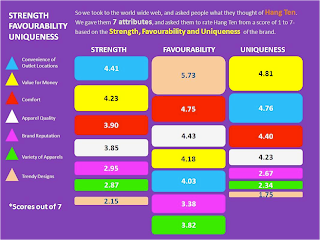
We expect to garner highest returns from this solution. Based on previous research, we concluded that Hang Ten’s consumers rank trendiness as the top factor in the favorability study, but trendiness was ranked last in terms of its role as a contributing factor to the strength and uniqueness of the brand.


Thus, with our strategy to promote Hang Ten as a trendy and youthful brand, we aim to improve its image and standing in the minds of consumers, and have it translated to heightened brand awareness and better sales.

We will be able to leverage on existing knowledge, to learn from competitors who are performing better in terms of their channel, product and communications strategies.

Risks Involved
Of course, implementation failure could occur when the customers are not receptive towards the brand revamp. This happens most often when a company undergoes a brand revamp, abandoning the loyal customers who are skeptical about the change. As such, Hang Ten will need to proceed with caution to not alienate these customers.

Feasibility of Strategy
However, this strategy is still the most feasible, because of the following four reasons:

1. Hang Ten would be able to capitalize past strengths, while improving the current marketing mix to strength brand equity.
2. Minimum cost will be incurred in implementing this strategy, because it requires the least overhaul.
3. As examined previously, the strategy involves the least risk, as it does not lead to a misalignment of internal company goals and drastic changes to the brand positioning and identity.
4.  We will be able to avoid any external conflict of interests of operational or copyright issues with the Hang Ten USA counterpart.

With this rationale in mind, the following entries will delve into our team's recommendations and marketing plans for revitalizing Hang Ten.

Brand Elements Decisions

Brand elements are the trademarkable devices that serve to identify and differentiate the brand. Since positioning and identity remains unchanged, the main brand elements of Hang Ten will not be altered to maintain a consistent brand story. We evaluate the overall memorability, meaningfulness, likability, transferability, adaptability and protectabilitty of Hang Ten's brand elements below.

1. "Hang Ten" brand name & logo

As suggested from previous research, Hang Ten's breadth of awareness is evident. Consumers can recognize the brand easily with its memorable, iconic two-feet logo. It is the same brand name and logo the Group uses, making these elements protectable and transferable. Hence, we recommend brand name and logo remain unchanged to leverage these strengths.

2. Slogan: "We're Hang Ten"
The current slogan is transferable as all regional Hang Ten stores in Asia employ it. The slogan plays off the brand name to create awareness and reinforce it in consumers' minds. Although it does not summarize the descriptive information of product offerings, it suggests inclusiveness and a sense of belonging. Coupled with our proposed marketing strategy, we will construct a friendly and approachable association in line with its image, making the slogan more meaningful.

3. URL website: http://www.hangten.com.sg  
The existing link is clear in defining the brand name and region. It is also protectable and meaningful. Possible Internet naming will follow such convention to ensure consistency and quick identifiability.